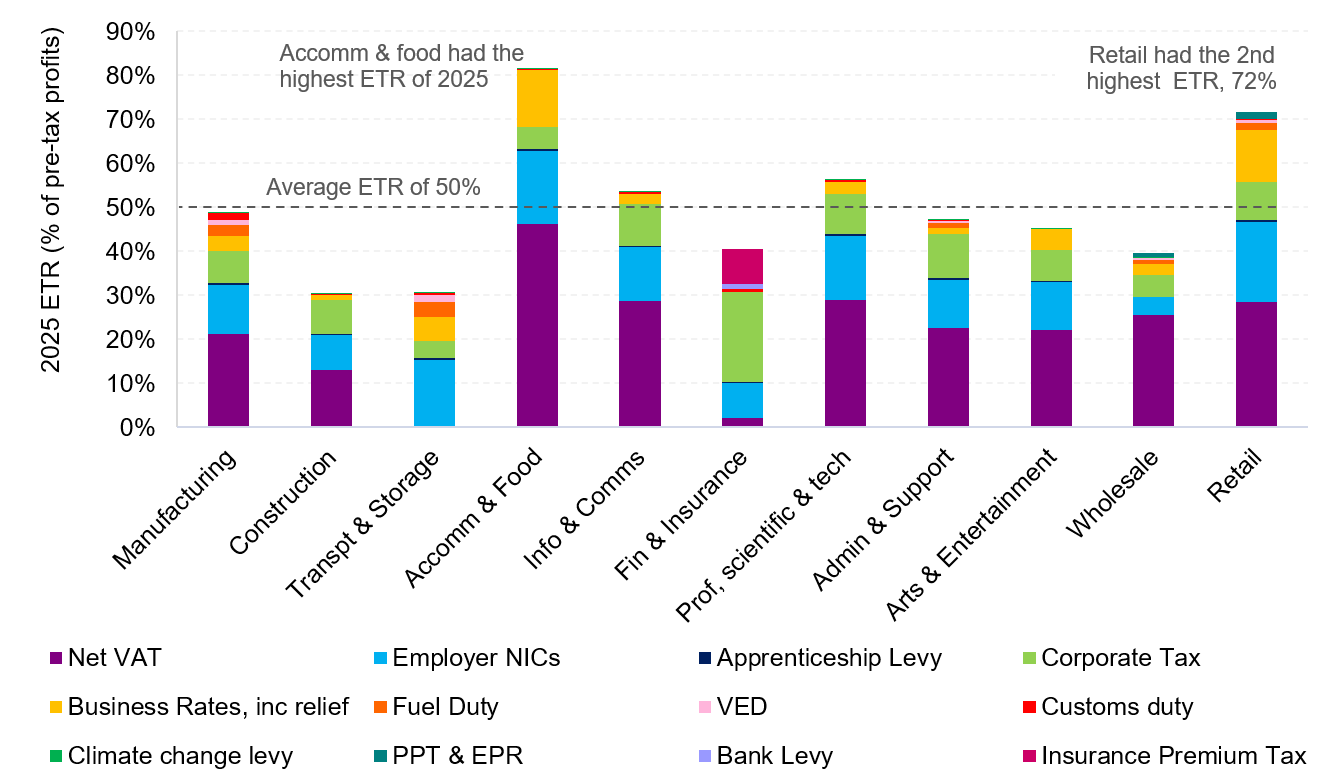
Retail and hospitality have the highest effective tax rates of
any sector in the UK, leading to fewer jobs for young people,
foregone investment, and higher prices for customers. New
analysis from the British Retail Consortium (BRC) compared the
taxes and profits paid in 11 main sectors of the economy. It
found the two sectors paid a combined £62 billion in taxes in
2025/26 through business rates, employer National Insurance
Contributions (NICs), VAT, and other government taxes.
Retail and hospitality are two of the nation's largest employers,
providing millions of jobs across every postcode. They are the
largest source of entry-level and flexible jobs, and a gateway to
employment and training for those without qualifications or
previous experience. However, the 2024 Budget added billions to
their employment costs. As a result, retail lost 122,000 jobs in
just two years, while employment in hospitality fell by 93,000
people.
For every £1 of pre-tax profit made by the sector, retailers paid
the equivalent of 72p in business taxes, while for hospitality
businesses this figure was 82p in the pound: these are the
highest rates for any sector, well above the 50p average
effective tax rate of all eleven main sectors of the economy,
including the 40.5p tax rate of the banking industry. Hospitality
and retail's effective tax rates rose further in 2026/27.
High streets are particularly exposed to the impact of rising
business taxes. The presence of retail and hospitality businesses
are what keep high streets vibrant and job opportunities
available. Yet they pay a disproportionate level of business
rates relative to other industries and together cover almost a
third of the total raised by the tax. The consequence is 1 in 7
high street properties across the country lie empty.
Higher taxes leave high street businesses with less money to
invest in jobs and local communities and put further upward
pressure on prices for shoppers. With inflation currently at
3.1%, well above the Bank of England's 2% target, further tax
rises risk adding to the cost-of-living pressures facing
households.
Ahead of the Budget, the BRC and UKHospitality are calling on the
Chancellor to put local communities first and reduce the cost
burden on these two sectors, including removing high street
retail and hospitality businesses from the government's business
rates high-value multiplier. Doing so will help protect the
millions of people working there and support those who would be
hit by higher prices if these warnings are ignored.
Helen Dickinson, Chief Executive at the British Retail
Consortium, said:
The Chancellor faces a choice: to continue to pile taxes onto our
high streets and the millions of households that rely on them, or
to give these businesses the breathing space needed to create
jobs, deliver growth, and hold down prices. Millions of people
rely on retail jobs across the country, but the overwhelming tax
burden puts those people at risk, with over 100,000 jobs lost in
the last two years.
For every £1 of pre-tax profit made by retail, the equivalent of
72p is now paid in business taxes. This punishing tax burden has
clear consequences: job losses, shuttered shops, and a missed
opportunity to drive growth in every postcode. For the benefit of
high streets, young people and shoppers everywhere, the
Chancellor should use the Budget to deliver a clear path to
reducing the rates burden, now and in the future.
, Chief Executive at
UKHospitality, said:
This staggering data proves what we have long been saying: that
hospitality is vastly overtaxed and has the highest tax burden in
the economy. With more than 80% of every pound made going back to
the Government, it is no surprise that our ability to create
jobs, drive growth and regenerate the high street has been
severely damaged.
If the Government wants to create jobs and drive growth in every
postcode, it needs hospitality and the high street firing on all
cylinders.
Hospitality's tax burden needs to be dramatically reduced. We
need an entire hospitality solution to business rates, which the
Government can achieve by increasing the retail, hospitality and
leisure discount and providing support to the businesses hardest
hit by the 2026 revaluation, in line with the support given to
pubs.
- ENDS
Notes to editors:
- This research includes independent economic analysis carried
out by Flint Global, commissioned by the BRC. The graphs below
illustrate the business tax burden facing retail, compared to
other sectors in 2025-26.
- Retail's tax burden was £39.1bn, while hospitality's burden
was £22.9bn
- This created an effective tax rate of 71.5% for retail, and
81.6% for hospitality.
- Retail Job losses between Q2 2026 and Q2 2024 were 122,000 on
a 4Q average. The industry employs 2.8m jobs. Data from ONS
Workforce Survey.
- Hospitality employment was down 93,000 between August 26 and
August 24. The industry employs 2.1m people. Data from the PAYE
data.
Effective tax rates faced by businesses: sectoral
breakdown, 2025-26