-
Local tax-take would replace current Integrated Settlement
up to 2029/30, before granting further local control in next
Spending Review
-
Proposals replace nearly £5 billion of mayors' funding from
Treasury with shares of locally generated income and
corporation tax revenues
-
Centre for Cities proposes fair, Swiss-style mechanism to
redistribute finance between places with the most and least
revenue
Centre for Cities has today published the first comprehensive
blueprint of how the UK Government should implement fiscal
devolution in England following its commitment to give mayors
access to a share of local tax receipts.
The blueprint is designed to maximise economic growth in local
areas while being cost neutral to the Treasury at the point of
rollout.
If implemented by the Government in its forthcoming Rewiring
the State White Paper, the proposals will see established
metro mayors become responsible for a taxbase of £5 billion per
year, equivalent to the central government grant currently funded
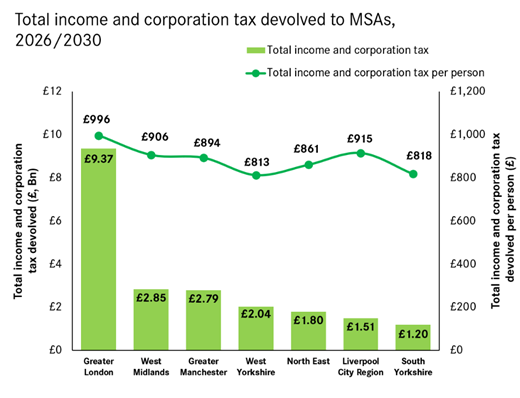
by Whitehall. The proposals would see an estimated £21.5 billion
devolved to mayors over four years to 2030, assuming historic
growth rates.
In its proposals, Centre for Cities recommends:
- Give mayors access to around 7% of locally generated income
tax receipts. This replaces around 90% of the value of the
current Integrated Settlement. The blueprint shows precisely the
share of income tax retention that is needed in each Mayoral
Strategic Authority.
- Include access to around 2% of locally generated corporation
tax to replace the remaining 10 per cent of the Integrated
Settlement. The Centre has described the role of corporation tax
as an essential carrot to incentivise mayors to grow and invest
in their high-productivity businesses, the proceeds of which will
be a vital driver of good growth in city regions.
- Use a "Swiss-style" redistribution system which ensures no
mayoral area falls below a minimum funding floor, with top-up
grants funded by tariffs on cities with the largest taxbases. In
addition, all mayoral areas will be guaranteed at least 100% of
their already-committed funding through to 2029/30.
After 2029/30, the blueprint sets out how mayors should, with
greater responsibilities, gain the power to collect an even
higher share of local tax revenue moving away from the
centrally-defined benchmarks set by the Integrated Settlements
and making local revenue streams the norm for funding local
services.
Centre for Cities' proposals follow the adoption by government of
its recommendations on how to design and rollout the Overnight
Visitor Levy, announced last week by the Secretary of State for
Housing, Communities and Local Government.
Centre for Cities has previously shown that the UK is among the
most fiscally centralised nations in the G7.
, Chief Executive of Centre
for Cities, said:
This Government has rightly placed fiscal devolution at the
centre of its plans to rewire the state. It is now critical that
it does not miss the opportunity to do so in a way that maximises
the potential for economic growth.
The nine biggest cities outside London contain 16 per cent of the
UK population but generate only 15 per cent of national economic
output. This sluggish performance is the reverse of what we
should expect from large urban economies. Giving mayors access to
a share of local taxes is an essential step in changing the
economic trajectory of Britian's cities. That is ultimately to
the benefit of every citizen in the country.
It is encouraging that the Overseas Visitor Levy will now be
rolled out everywhere. It marks the first tentative step towards
fiscal devolution. That the Government has placed income tax
sharing at the heart of its plan for wider fiscal devolution is
also sensible and correct.
There is a real risk though that a vital lever is missed. It has
been said that devolving a share of corporation tax is too
complex. We show that this is not true. If the Government wants
good growth in every postcode, corporation tax should be an
essential, pro-economy part of its plan for fiscal devolution.
