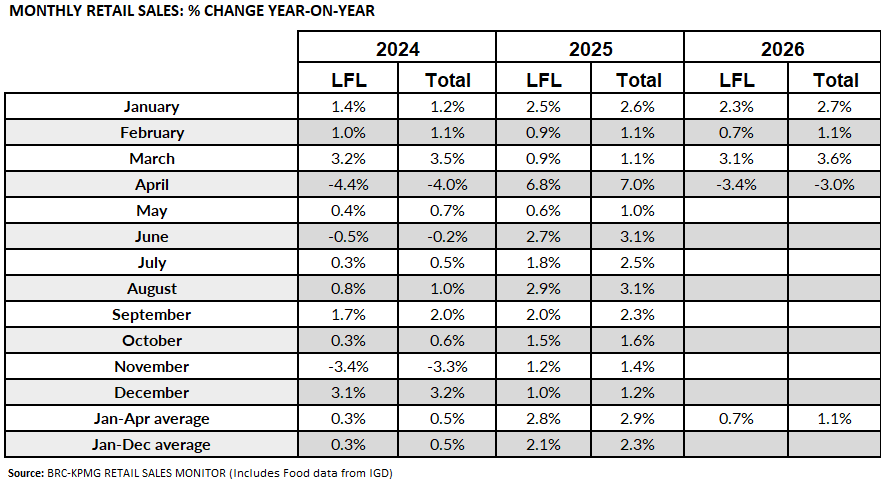
This year, the run up to Easter fell in the March
figures, while last year it was in April. This calendar change
distorts the year on year comparisons - resulting in an
artificially higher March, but lower April. To compensate, we
have also provided a combined March and April YoY comparison,
which would cancel out this effect over the two month
period.
Covering the 4 weeks of 5 April – 2 May 2026
- UK Total retail sales decreased by 3% year on year in April,
against a growth of 7% in April 2025. This was below the 12-month
average growth of 1.8%.
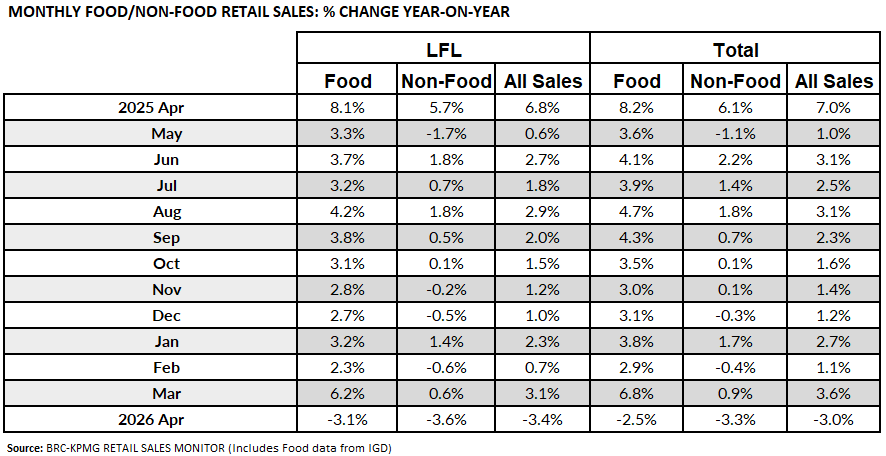
- Food sales decreased by 2.5% year on year in April, against a
growth of 8.2% in April 2025. This was below the 12-month average
growth of 3.5%.
- Non-Food sales decreased by 3.3% year on year in April,
against a growth of 6.1% in April 2025. This was below the
12-month average growth of 0.3%.
- In-Store Non-Food sales decreased by 4.0% year on year in
April, against a growth of 5.6% in April 2025. This was below the
12-month average growth of 0.4%.
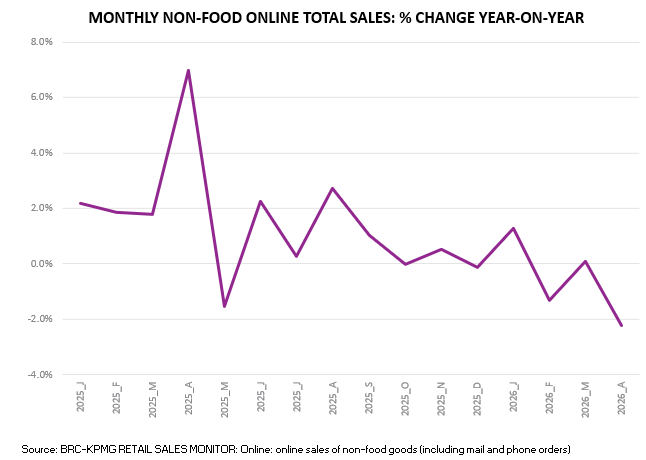
- Online Non-Food sales decreased by 2.3% year on year in
April, against a growth of 7% in April 2025. This was below the
12-month average growth of 0.3%.
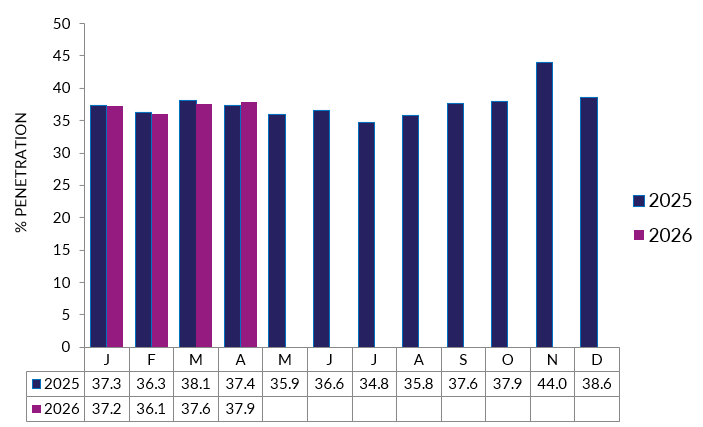
- The online penetration rate (the proportion of Non-Food items
bought online) increased to 37.9% in April from 37.4% in April
2025. This was above the 12-month average of 37.5%.
Taking March and April together, and comparing
them with the same two-month period in 2025 (to account for the
timing of Easter):
- UK Total retail sales increased by 1.5% year on year
Helen Dickinson, Chief Executive at the British Retail
Consortium, said:
“April's sales fall was largely driven by the Easter shift, with
food hit hardest. But weak consumer confidence also played a role
as fears about the Middle East conflict driving up living costs
led shoppers to rein in. Big-ticket purchases fell, with the
recent recovery in furniture losing steam, and uncertainty around
summer holidays hitting discretionary spend. With the World Cup
coming, retailers hope it will provide a lift, and early signs
show demand for TVs and sound systems picking up.
“Global events might be out of government's hands, but costs
imposed at home are not. Ministers must act now to curb the
impact on consumers from soaring costs. That means cutting
non-commodity energy charges – which include the taxes and levies
that make up to two thirds of retailers' energy bills, scrapping
or reforming the triple tax on packaging, and delaying the
upcoming changes to the way we measure the nutritional content of
food. The time to act is now if government wants to protect
consumers and support growth in the challenging few months
ahead.”
Linda Ellett, UK Head of Consumer, Retail & Leisure,
KPMG, said:
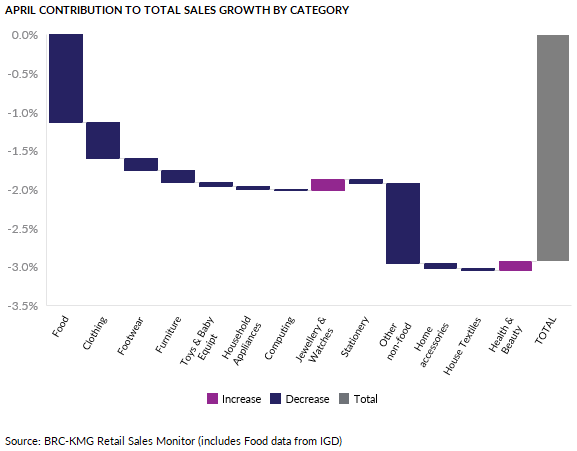
“It was a disappointing April for the retail sector, even
factoring in an earlier Easter shifting some spending into March.
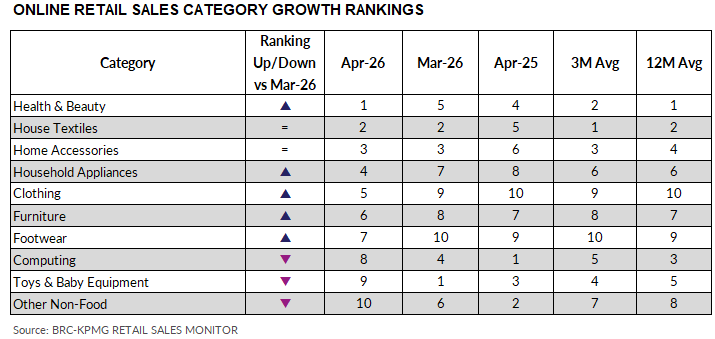
Bar marginal growth for beauty, health and jewellery, retail
sales fell across all other categories.
“Consumer confidence has been further dampened by rising prices
due to the Iran conflict, with consumers cautious about potential
ongoing effects. As a result, the retail sector is facing a
challenging start to spring/summer, but there is hope that
holiday demand and the World Cup still manage to unlock spending
in the weeks and months ahead.”
Food & Drink sector performance | Sarah Bradbury,
CEO, IGD, said:
“The impact of food price inflation is increasingly split by
income, as lower‑income households are already feeling the impact
of higher fuel costs and remain highly value‑focused, while
higher‑income shoppers are more insulated, supported by elevated
market interest rates and the upside for savings. Retail value
growth has slowed sharply year on year and volumes remain fairly
flat, signalling continued budget‑management for shoppers. News
of a temporary ceasefire in the Middle East lifted shopper
confidence briefly, but with broader energy‑market disruption
likely to feed through to food inflation with a time lag,
pressure is expected to build over the next few months. Food and
drink retailers should plan for continued trade‑down from
shoppers, heightened promotional activity, and uneven demand.”