Period Covered: 01 – 07
January 2024
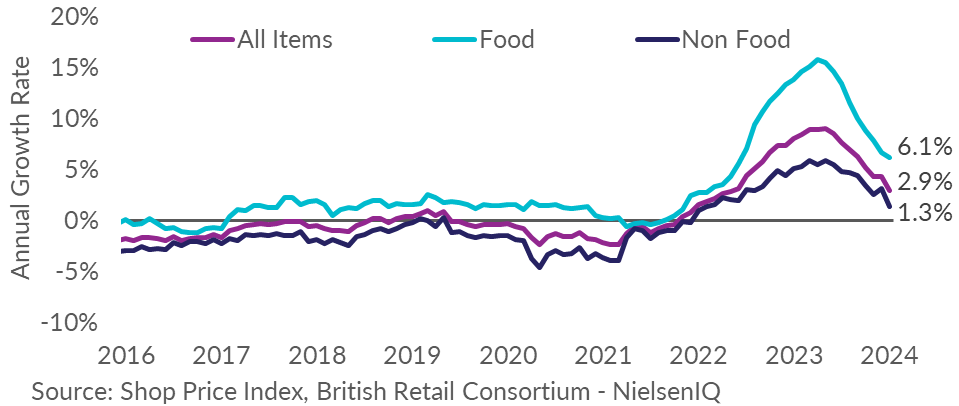
- Shop Price annual inflation eased to 2.9% in January, down
from 4.3% in December. This is below the 3-month average rate of
3.9%. Shop price annual growth is its lowest since May 2022.
- Non-Food inflation fell to 1.3% in January, down from 3.1% in
December. This is below the 3-month average rate of 2.4%.
Inflation is its lowest since February 2022.
- Food inflation decelerated to 6.1% in January, down from
6.7% in December. This is below the 3-month average rate of 6.8%
and is the ninth consecutive deceleration in the food category.
Inflation is its lowest since June 2022.
- Fresh Food inflation slowed further in January, to 4.9%, down
from 5.4% in December. This is below the 3-month average rate of
5.6%. Inflation is its lowest since May 2022.
- Ambient Food inflation decelerated to 7.7% in January, down
from 8.4% in December. This is below the 3-month average rate of
8.5% and is the lowest since July 2022.
|
|
OVERALL SPI
|
FOOD
|
NON-FOOD
|
|
% Change
|
On last year
|
On last month
|
On last year
|
On last month
|
On last year
|
On last month
|
|
Jan-24
|
2.9
|
-0.7
|
6.1
|
0.7
|
1.3
|
-1.4
|
|
Dec-23
|
4.3
|
0.4
|
6.7
|
0.0
|
3.1
|
0.5
|
Note: Month-on-month % change refers to changes in the
level of prices.
Helen Dickinson, Chief Executive of the British Retail
Consortium, said:
“Some New Year cheer as January shop price inflation slid to its
lowest level since May 2022. Non-food goods drove the fall, as
many retailers offered heavily discounted goods in their January
sales to entice consumer spend amidst weak demand. Good news for
the morning brew as the price of tea and milk fell, while evening
tipples remained more expensive on the back of increased alcohol
duties.
“Retailers have spent the last eight months working to bring down
inflation, but progress will likely be hampered by new cost
pressures coming direct from government – including implementing
the increase in the National Living Wage on top of an above
inflation rise in business rates this April, a potential new
grocer ‘surtax’ in Scotland, and ill-conceived recycling
proposals. Rising geopolitical tensions will also add to
uncertainty and costs in supply chains. With a General Election
later this year, we want to see political parties outline how
they will help unlock investment across the country rather than
the current trajectory which is doing just the opposite.”
Mike Watkins, Head of Retailer and Business Insight,
NielsenIQ, said:
"Shoppers are seeing savings at the
checkout with non-food retailers on promotion and food retailers
continuing to reduce prices when the costs of goods fall.
However, consumer demand remains fragile as most households are
yet to feel better off after nearly 2 years of inflation.”
