The Environment Agency has launched a long-term plan for
meeting the challenges our water supplies are likely to
face as a result of climate change and population growth.
The National Framework
for Water Resources, launched today, brings together
industry, regulators and government to transform the way we
use and look after our water supplies. The framework will
help reduce demand, halve leakage rates, develop new
supplies, move water to where it’s needed and reduce the
need for drought measures that can harm the environment.
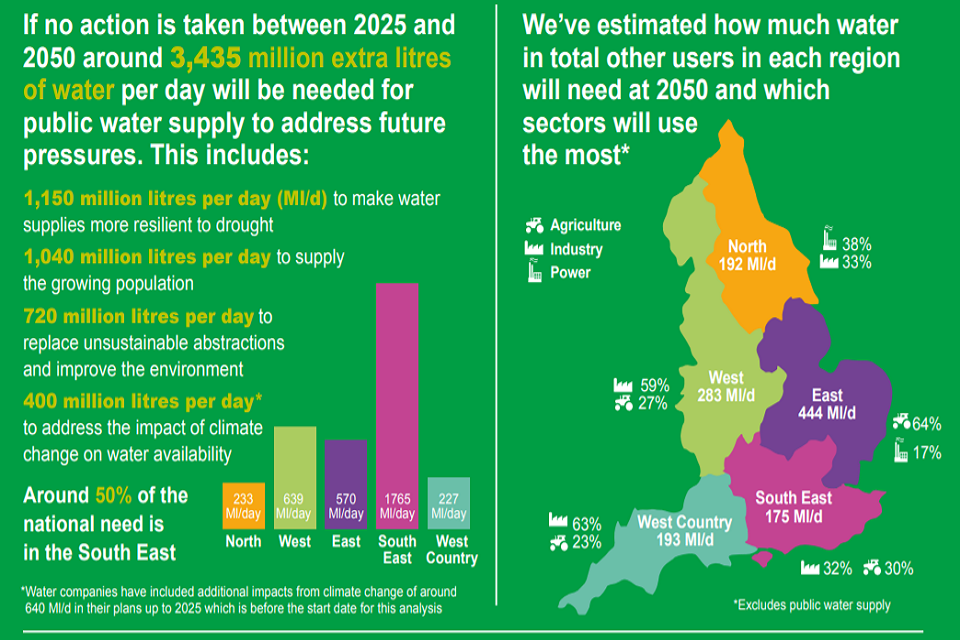
The latest predictions estimate that if further action is
not taken, between 2025 and 2050 we’ll need more than 3.4
billion additional litres of water per day to meet future
demand for public water supply.
The framework looks to ease the pressure on our future
water supplies by:
- Reducing demand to an average of 110 litres per person
per day by 2050
- Improving water efficiency across all sectors
- Working with water companies to halve leakage rates by
2050
- Developing new supplies such as reservoirs, water
re-use schemes and desalination plants
- Making it easier to move water to where it’s needed
through regional water transfers
- Reducing the use of drought measures that can impact
the environment
The framework introduces an ambitious aim for water
companies to help consumers cut wastage and to use water
more wisely in order to reduce our average water use from
143 to 110 litres per day.
Five regional groups across the country will work up plans
tailored to the specific needs of their individual area,
bringing together the 17 English water companies, industry
regulators, government and other water users. The framework
will guide these groups and deliver a national blueprint
for future water resources planning from 2025 to 2050 and
beyond.
The framework also sets out the challenges that
water-intensive industries such as agriculture and power
generation are likely to face across different parts of the
country as a result of climate change, and how we can
overcome them.
It also sets a greater level of ambition for restoring,
protecting and improving the environment that is the source
of all our supplies.
, Environment Minister,
said:
I am pleased to see the Environment Agency challenging
water companies to work more collaboratively to increase
water efficiency.
This framework is a significant step in the right
direction, bringing together consumers, businesses and
industry to reduce our water demand, and to put in place
the infrastructure we need while preserving our water
environment for decades to come.
Emma Howard Boyd, Chair of the Environment Agency, said:
If we don’t take action many areas of England will face
water shortages by 2050. The National Framework for Water
Resources is the step change required to ensure the needs
of all water users are brought together to better manage
and share resources. Collaboration is key if we are going
to deliver the resilience and environmental enhancement
we need.
Dame Kate Barker of the National Infrastructure Commission
said:
With demand for water growing and the stability of supply
under challenge from climate change, we need a coherent
long term plan that ensures England’s water system is
resilient to drought while continuing to provide a
reliable supply to families and businesses.
We welcome this framework’s bold vision, in line with the
conclusions in our National Infrastructure Assessment. It
is clear about the need to protect our natural
environment and promotes collaboration between water
companies, regulators, government and major users to
reduce demand, increase supply and better share scarce
water resources.
Rob Light, Chair of the Consumer Council for Water, said:
We hope the framework will be a catalyst for the whole
sector to unify its efforts in tackling one of the most
urgent consumer and environmental challenges of our time
– safeguarding the future of our water resources. It’s
great we now have a clear plan in place but people will
judge the sector on its actions.
Consumers want a safe, reliable supply of water but they
also expect water companies to be good stewards of our
rivers, streams and natural environment which also depend
on there being enough water to survive. All of us have a
part to play in the way we use water, but it’s vital we
help consumers understand the scale of the problem and
the steps that will need to be taken if we want them to
be part of the solution.
You can access the full framework document and
summary here.
The future pressures on our water environment if no action
is taken.
Notes to editors
-
Five regional groups include a wide membership of water
users outside the water industry as well as the local
water companies. Water company membership is: Water
Resources North (Northumbrian Water, Hartlepool
(Anglian) Water, Yorkshire Water. Water Resources West
(Severn Trent Water, United Utilities, South Staffs
Water, Welsh Water). Water Resources East (Anglian
Water, Essex and Suffolk Water, Cambridge Water, Severn
Trent Water, Affinity Water). Water Resources South
East (Affinity Water, Portsmouth Water, South East
Water, Southern Water, SES Water, Thames Water). West
Country Water Resources (Bristol Water, Wessex Water,
South West Water).
-
The National Framework is primarily focused on England
as this is the Environment Agency’s remit. However,
Welsh Government and Natural Resources Wales have been
involved in the work and are represented on the senior
steering group. This is to make sure that any proposals
that may affect Wales have due regard to the interests
of Wales, in particular, sustainable management of its
natural resources and welsh legislation and policies.
They are also represented in the Water Resources West
group.
-
Regional groups will plan to achieve a level of drought
resilience so that emergency drought order
restrictions, such as providing water only at certain
times of the day (rota cuts) or through temporary taps
(standpipes) in the streets, are expected to be
implemented no more often than once in 500 years on
average.