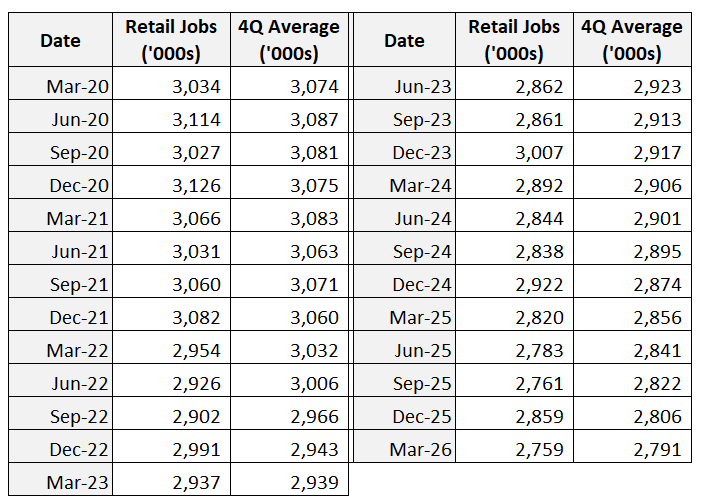
According to the latest ONS figures, there were 2.76 million
retail jobs in March 2026, raising concerns that rising
employment costs are reducing the number of entry-level and
flexible job opportunities available across the industry.
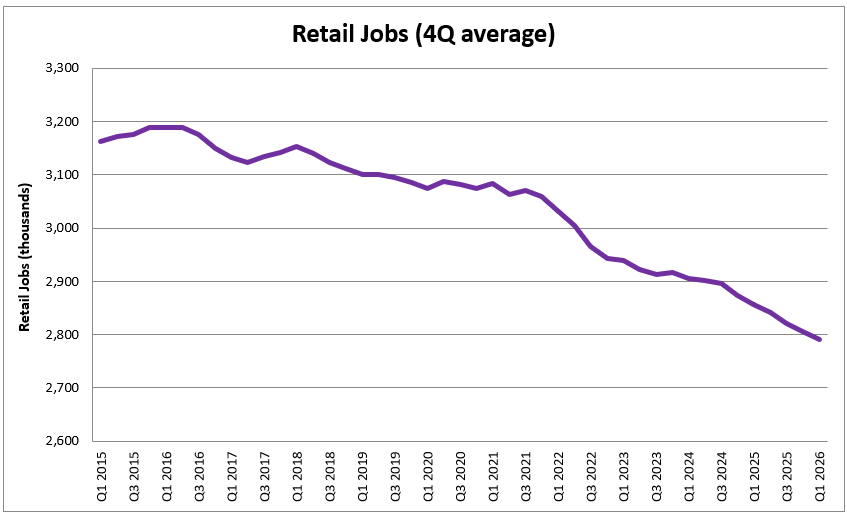
Using the four-quarter average which smooths out the seasonal
variations in hiring, there was was 2.79 million jobs for
Q1 2026, 66,000 fewer than a year earlier, and 398,000
fewer than in Q1 2016. This four-quarter average is the lowest on
record.
Using the four-quarter average, there were 1.27 million full-time
and 1.52 million part-time jobs. The number of full-time jobs was
down 163,000 on a decade ago. Meanwhile, the number of part-time
jobs is down 235,000 over the same period.
Declining retail employment comes as the industry faces an
additional £6.5 billion in employment costs over a 14-month
period as a result of increases to employer National Insurance
Contributions and the National Living Wage.
Retail leaders have also raised concerns that aspects of the
Employment Rights Act, if implemented without sufficient
flexibility, could make it harder for businesses to offer the
flexible and entry-level roles that many people rely on.
As the UK's largest private sector employer, retail provides
hundreds of thousands of flexible and entry-level opportunities.
In a recent letter coordinated by the British Retail Consortium,
more than 80 retail CEOs warned that rising employment costs and
additional regulatory burdens risk closing off opportunities for
young people and reducing the flexible roles relied upon by
students, parents and carers.
Commenting on these figures, Helen Dickinson, Chief
Executive at the British Retail Consortium, said:
The impact of rising employment costs cannot be ignored. Retail
has long been the UK's main job creator, but that is becoming
harder to sustain. Employment has fallen to a record low as costs
continue to rise. At a time when the economy needs growth,
retailers and households need policies that support job creation,
not puts them at risk.
For the young, the pressures are greater, with the number of
young people not in education, employment, or training to reach
1.25 million over the next five years. Retail and its supply
chain is almost a quarter of all youth employment. Flexible,
entry-level roles that help people gain skills, confidence and
experience and are a vital route into work, but rising employment
costs and additional regulatory burdens are choking off
opportunities at a time when they're needed most.
If government is serious about tackling youth unemployment, it
must bring down the cost of employing young people and ensure
employment reforms support entry-level recruitment and
progression. Retailers stand ready to work with government to
help more young people take that crucial first step on the career
ladder.
-ENDS-
ONS jobs figures are reached by adding Retail trade, except
of motor vehicles and motorcycles of:
-
Jobs03: Employee jobs by
industry
-
Jobs04: Self-employment by
industry
Jobs03 data goes back to 1978, while Jobs04 data only goes back
to 1996. This means Total figures (and records) only go from
1996.
Any discrepancies with the figures the BRC published last quarter
are due to revisions of previous data made by the ONS.
