Period Covered: 01 – 07
April 2026
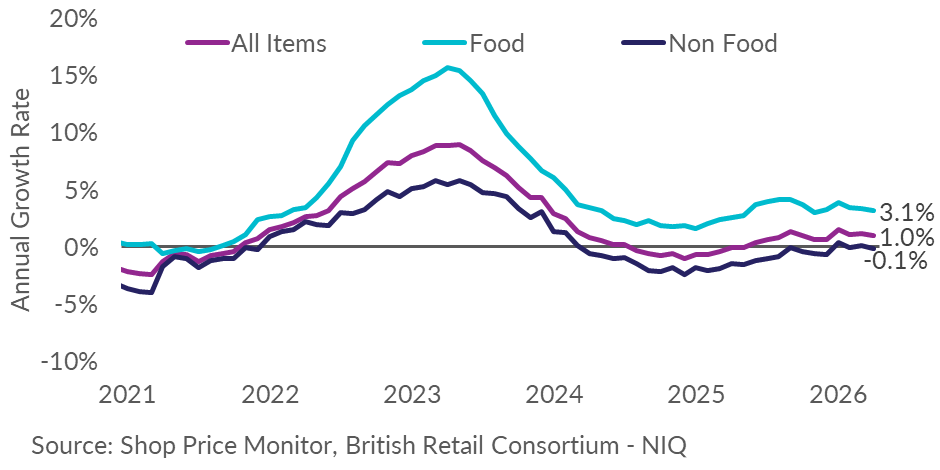
- Shop price inflation decreased to 1.0% year on year in April,
against growth of 1.2% in March. This is below the 3-month
average of 1.1%.
- Non-Food inflation decreased to -0.1% year on year in April,
against growth of 0.1% in March. This is below the 3-month
average of 0.0%.
- Food inflation decreased to 3.1% year on year in April,
against growth of 3.4% in March. This is below the 3-month
average of 3.3%.
- Fresh Food inflation decreased to 3.9% year on year in April,
against growth of 4.4% in March. This is below the 3-month
average of 4.2%.
- Ambient Food inflation increased to 2.1% year on year in
April, against growth of 2.0% in March. This is in line with the
3-month average of 2.1%.
|
|
OVERALL SPM
|
FOOD
|
NON-FOOD
|
|
% Change
|
On last year
|
On last month
|
On last year
|
On last month
|
On last year
|
On last month
|
|
Apr-26
|
1.0
|
-0.2
|
3.1
|
0.5
|
-0.1
|
-0.6
|
|
Mar-26
|
1.2
|
-0.1
|
3.4
|
-0.1
|
0.1
|
0.0
|
Note: Month-on-month % change refers to changes in the
level of prices.
Helen Dickinson, Chief Executive of the BRC,
said:
“Bigger discounts in clothing, furniture and DIY goods helped
pull down shop price inflation in April. With weakening consumer
confidence, retailers competed harder on price to stimulate more
spring spending. Food price inflation also slowed as retailers
offered discounts on Easter items such as chocolate. While we're
yet to see the full force of the Middle East conflict feeding
into consumer prices, it will not be long before it begins
to.
“Retailers already face mounting cost pressures from domestic
policies, with an extra £10bn a year added over the last two
years from employment costs, packaging taxes and more. This will
be compounded as rising fuel, fertiliser, and commodity prices
begin to feed into business costs. Government can help moderate
shop price inflation by fixing the non-commodity charges which
inflate businesses energy bills. This could help mitigate the
peak in food inflation, reducing the squeeze on struggling
households who will ultimately bear the brunt.”
Mike Watkins, Head of Retailer and Business Insight, NIQ,
said:
“Increased fuel prices are already leading to higher inflation,
and we can expect a similar impact in the food and non-food
supply chains in the months to come. However, retailers will look
to hold back any price increases as long as possible as alongside
fragile consumer confidence, accelerating inflation is likely to
negatively affect consumer spending.”
