Conservative response to public sector finances
Sir MP, Shadow
Chancellor, said:
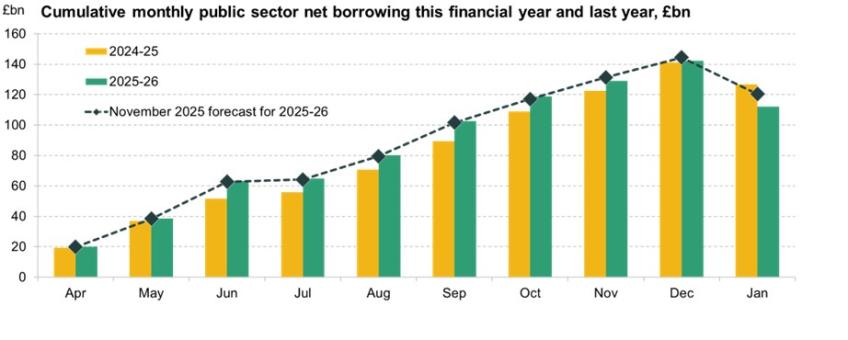
“Labour have borrowed £112.1 billion so far this year - the fifth
highest borrowing on record. Record high taxes and irresponsible
spending have weakened the economy.
“With youth unemployment now higher than in Europe, inflation
above target and the economy stagnant, is
right: Labour have “no growth strategy”. Neither Labour nor
Reform have the serious answers to stabilise the public finances.
“Only the Conservatives have a leader with a backbone, the plan
and the team to get Britain working again.”
ENDS
Notes to Editors:
Labour have made irresponsible choices:
-
Labour's hiked taxes by £26 billion – pushing the
tax burden to a historic high. Despite her pledge not
to ‘come back for more',
increased taxes by £26 billion, pushing the tax burden to a
historic high of 38.3 per cent of GDP (OBR, Economic and
Fiscal Outlook, 26 November 2025, archived).
-
Welfare spending will reach £406 billion by the
end of the scorecard after Labour abandoned their welfare
reforms. Labour's failure to reform welfare means
welfare spending will reach £406 billion by the end of the
scorecard (OBR, Economic and Fiscal Outlook, 26
November 2025, link).
As a result, the economy is weaker:
-
Economic growth has remained sluggish. After a year of
sluggish growth, GDP growth was just 0.1 per cent in the three
months to December, after a fall of 0.1 per cent in the three
months to November (ONS, GDP monthly estimate, UK: December
2025, 12 February 2026, link).
-
admitted Labour have ‘no growth strategy at all'. On
28 March 2025,
admitted to his mentor Peter that
Labour have ‘no growth strategy at all'. This was two
days after
Spring Statement, where
claimed ‘we on this side of the house are serious about
taking the action needed to grow our economy' (HM Treasury,
Spring Statement 2025 speech, 26 March 2025,
link).
-
Inflation is above target. Having inherited
inflation bang on the 2.0 per cent target, new figures show it
rose by 3.0 per cent in the 12 months to January 2026, meaning
inflation has exceeded the Bank of England's target every month
since Labour's first Budget (ONS, Consumer Price Inflation,
UK: January 2026, 18 February 2026, link).
-
The unemployment rate is 5.1 per cent, its highest
level since the pandemic. The unemployment rate for 16
and over reached 5.2 per cent in October to December 2025, up
from 4.2 per cent at the election. Additionally, the November
2025 Economic and Fiscal Outlook raised the forecast
unemployment rate for each year from 2026 through 2029 (ONS,
Labour market overview, UK: February 2026, 17 February
2026, link).
-
The 16-24 youth unemployment rate is 16.1 per cent,
up 2.7 percentage points on Labour's watch.The 16-24
unemployment rate was 16.1 per cent in September to November
2025, up from 13.4 in April to June 2024 when the
Conservatives left office (ONS, Unemployment rate: UK:
All: Aged 16-24, 20 January 2026, link).
Institute for Fiscal
Studies
Responding to today's ONS figures on the public finances, Nick
Ridpath, Research Economist at the Institute for Fiscal Studies,
said:
“Today's data on the public
finances is particularly important, given the
outsized impact of
January's self-assessment returns on
revenues and borrowing for the year as a
whole. Income tax receipts had been a little
disappointing over 2025, lagging
behind forecasts even as inflation and wage growth
exceeded expectations. But today's data shows that
self-assessment revenues in January were almost £2
billion (6%) higher than forecast. The
government's plan to run a current budget surplus from 2028-29
onwards is reliant on marked reductions in borrowing over the
next few years – reductions that will be far easier to achieve
if tax revenues continue to come in
strongly.”
Today, the Office for National
Statistics published new figures on government revenues, spending
and borrowing:
-
The government normally runs a
surplus in January. In other words, it raises more than it
spends. Today's figures show that the surplus in January was
£30 billion. This is more than double the
figure for the same month last year,
and a £6 billion improvement
on OBR's forecast from November. Much of
the gap stems from significantly lower debt interest spending
in January: the government spent £2.3 billion
servicing its debt last month, around £4
billion below what was forecast by the
OBR.
-
Government borrowing is expected
to be lower this year than last, as the
government takes further steps towards its target
for current budget surplus by 2029-30. Cumulative
borrowing over the first ten months of this
year is £15 billion lower than last
year, meaning that borrowing is coming
down even faster than
expected
-
Public finance data from January
is particularly important, as it is
when a large share of self-assessment
income tax is
paid. Income tax receipts have been
disappointing up to this point in
the financial year, lagging
behind forecasts despite inflation and
wage growth surpassing
expectations. Today's data shows that for the
second straight month, income tax receipts have
surpassed the forecast produced only back in
November. This may be a welcome sign that
government receipts are starting to get the boost from
inflation and wage growth earlier in the
year.
These figures will be revised and
revised again, and so we should not place too much weight on
figures from any single month. All the same, out-turn
data does provide important insights into the state of
the economy and public finances, and points to issues that
could affect the Office for Budget Responsibility's forecast
in a couple of weeks time.
Figure 1. Cumulative monthly
public sector net borrowing, outturns and OBR
forecast