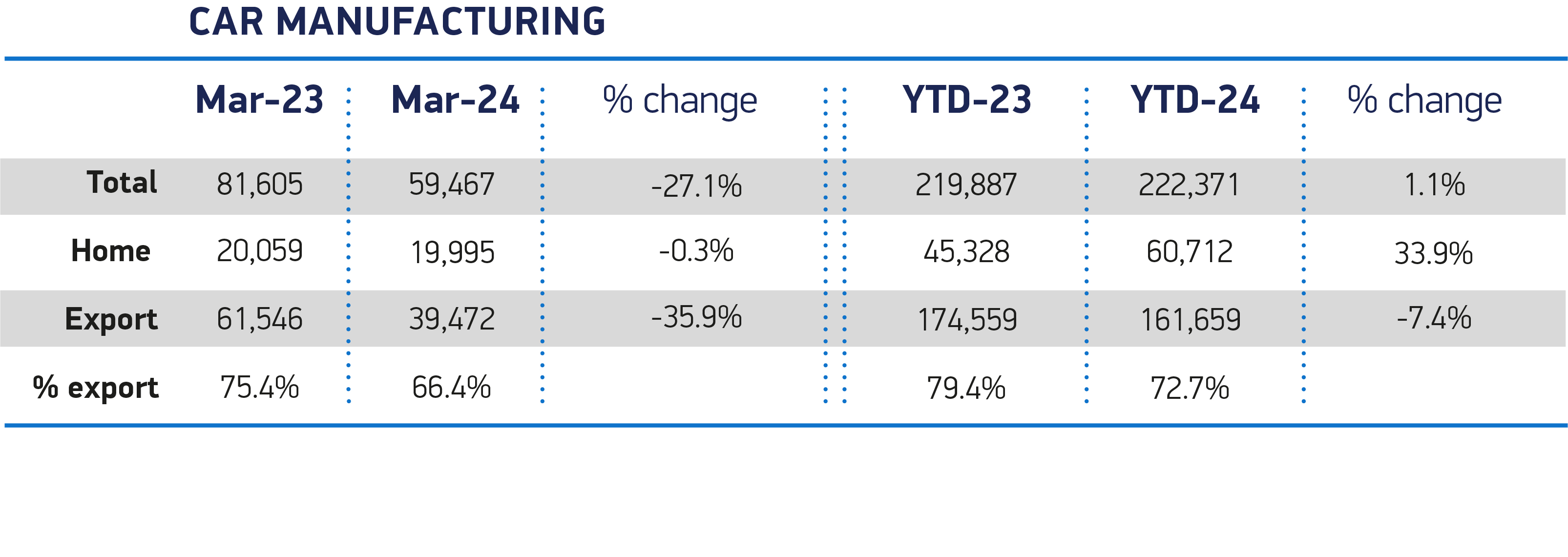
UK car production declined in March, down -27.1% year on year to
59,467 units, according to the latest figures published today by
the Society of Motor Manufacturers and Traders (SMMT).
It was the first fall since August last year and is in line with
expectations for a variable year, as manufacturers adjust
factories to produce the next generation of cars, notably
electric, winding down volumes of existing models in the process.
An early 2024 Easter bank holiday also played a part, with fewer
working days this March than the year before.
Volumes for the UK declined marginally, down just -0.3% to 19,995
units, while production for export fell -35.9% to 39,472 units,
although more than six-in-10 cars made in March were shipped
overseas. Continuing recent trends, the European Union received
by far the bulk of exports (57.9%) followed by the US (11.4%),
China (5.9%), Australia (4.0%) and Japan (1.8%). Shipments to the
top five export markets, apart from the US, all fell.
Electrified vehicle (battery electric, plug-in hybrid and hybrid)
volumes again represented more than a third of all production
(38.4%) with manufacturers producing a combined
22,865 units, although this was down -29.7% on the year
before in part reflecting the issues outlined earlier, notably
model changeovers.
Overall, UK car production remained up 1.1% in the first quarter,
at 222,371 units, with a 33.9% rise in output for the UK
offsetting a -7.4% decline in exports. Despite this fall, by far
the majority – 72.7% – of all cars made in Britain in Q1 were for
export.
Mike Hawes, SMMT Chief Executive, said, “This
fall is not unexpected given the wholesale changes taking place
within UK car factories as existing models are run out and more
plants transition to electric vehicle production. We can expect
further volatility throughout 2024 as manufacturers lay the
foundations for a successful zero emission future. Recent
investment announcements have boosted confidence and enhanced the
UK's reputation but there needs to be an unrelenting commitment
to competitiveness. Free and fair trade deals must be secured,
energy costs reduced and the workforce upskilled if we are to
attract further investment to improve productivity and
decarbonise automotive manufacturing and its supply chain.”
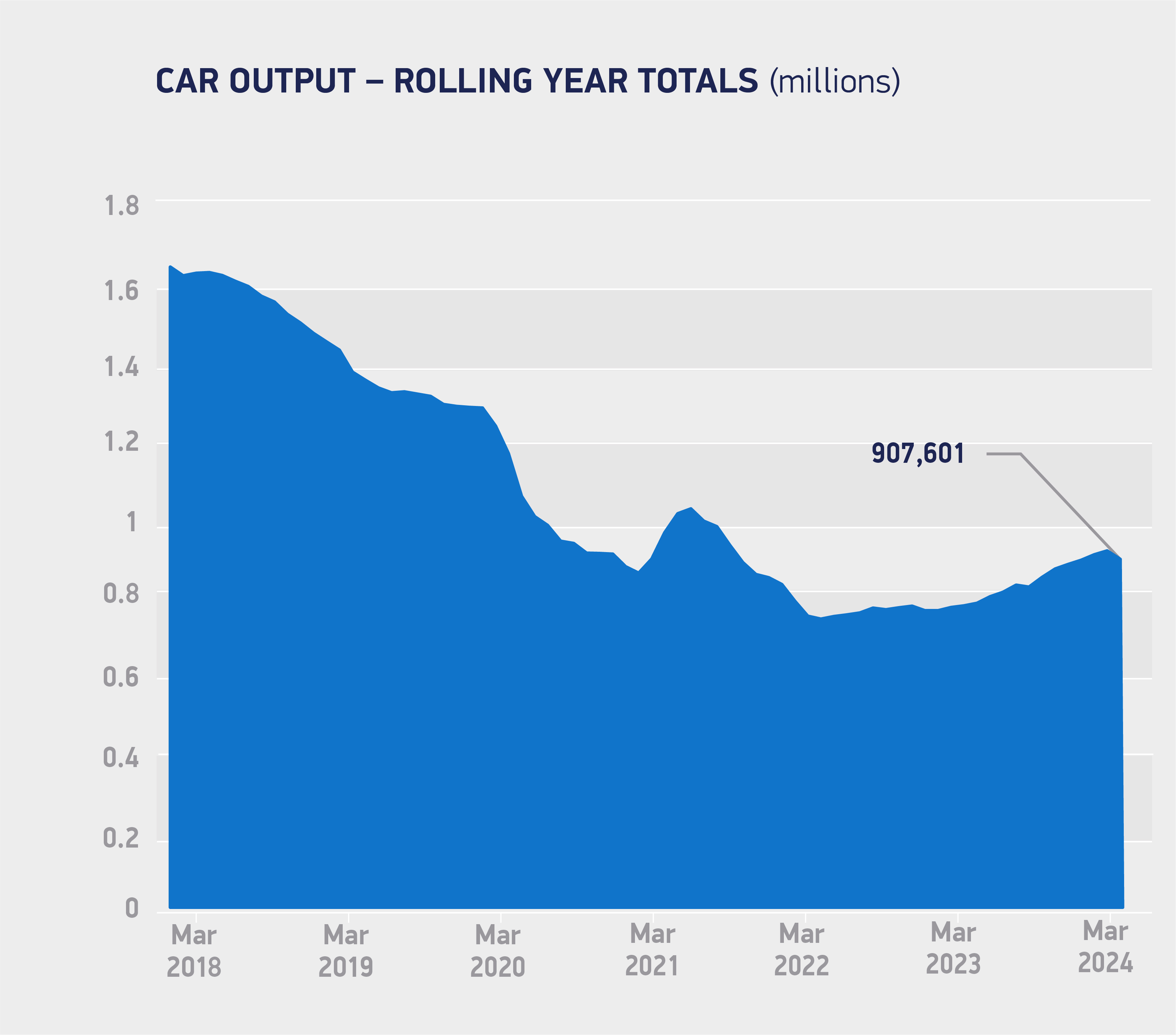
The latest independent production outlook now expects UK car and
light van production to fall -6.2% to some 940,000 units this
year, mainly due to multiple model changeovers, before returning
to growth in 2025. Output is anticipated to get back above a
million units from 2026 and reach 1.2 million before the end of
the decade as more EV production comes on stream across the
UK.1
|
|
|
|
|
|
|
|
|
|
|
|
|
|
|
|
|
|
|
|
|
|
|
|
|
|
|
|
|
|
Notes to editors
1: Based on AutoAnalysis independent Production Outlook
report, March 2024
About SMMT and the UK automotive
industry
The Society of Motor Manufacturers and Traders (SMMT) is
one of the largest and most influential trade
associations in the UK. It supports the interests of the
UK automotive industry at home and abroad, promoting the
industry to government, stakeholders and the media.
The automotive industry is a vital part of the UK economy
and integral to supporting the delivery of the agendas
for levelling up, net zero, advancing global Britain, and
the plan for growth. Automotive-related manufacturing
contributes £78 billion turnover and £16 billion value
added to the UK economy, and typically invests around £3
billion each year in R&D. With more than 208,000
people employed in automotive manufacturing, and some
800,000 in total across the wider sector, the industry
trades globally, with exports worth £94 billion
accounting for 10% of all UK goods exports.
More than 25 manufacturing brands build more than 70
models of vehicles in the UK, plus an array of specialist
small volume manufacturers, supported by some 2,500
supply chain businesses and some of the world's most
skilled engineers. Many of these jobs are outside London
and the Southeast, with wages that are around 14% higher
than the UK average. The automotive sector also supports
jobs in other key sectors – including advertising,
finance and logistics.
|
