- Record increase in global gas prices sees energy price cap
rise of 54%
- Ofgem knows this rise will be extremely worrying for many
people
- Customers struggling to pay their energy bill should contact
their supplier to access the help available
The energy price cap will increase from 1 April for approximately
22 million customers. Those on default tariffs paying by direct
debit will see an increase of £693 from £1,277 to £1,971 per year
(difference due to rounding). Prepayment customers will see
an increase of £708 from £1,309 to £2,017.
The increase is driven by a record rise in global gas prices over
the last 6 months, with wholesale prices quadrupling in the last
year.
It will affect default tariff customers who haven’t switched to a
fixed deal and those who remain with their new supplier after
their previous supplier exited the market.
The price cap is updated twice a year and tracks wholesale energy
and other costs.
It stops energy companies from making excessive profits, ensuring
customers pay no more than a fair price for their energy.
The price cap allows energy companies to pass on all reasonable
costs to customers, including increases in the cost of buying
gas.
Since the price cap was last updated in August, the current level
does not reflect the unprecedented record rise in gas prices
which has since taken place.
Under the price cap mechanism, energy companies will be allowed
to pass on these higher costs from April when the new level takes
effect.
This is because energy companies cannot afford to supply
electricity and gas to their customers for less than they have
paid for it.
Over the last year, 29 energy companies have exited the market or
been put in special administration in the wake of soaring global
gas prices, affecting around 4.3 million domestic customers.
, chief executive of
Ofgem, said:
“We know this rise will be extremely worrying for many people,
especially those who are struggling to make ends meet, and Ofgem
will ensure energy companies support their customers in any way
they can.
“The energy market has faced a huge challenge due to the
unprecedented increase in global gas prices, a once in a 30-year
event, and Ofgem’s role as energy regulator is to ensure that,
under the price cap, energy companies can only charge a fair
price based on the true cost of supplying electricity and
gas.
“Ofgem is working to stabilise the market and over the longer
term to diversify our sources of energy which will help protect
customers from similar price shocks in the future.”
Ofgem will tomorrow announce further measures to help the energy
market weather future volatility by increasing financial
resilience and have the flexibility to respond so that risks are
not inappropriately passed on to consumers. This follows measures announced in
December.
The further measures include enabling Ofgem to update the price
cap more frequently than once every 6 months in exceptional
circumstances to ensure that it still reflects the true cost of
supplying energy.
Notes to editors
- Help available for customers:
- If customers are struggling to pay for energy bills, they
should contact their energy supplier as soon as possible.
Depending on their circumstances, customers may be eligible for
extra help with their energy bills or services, such as debt
repayment plans, payment breaks, emergency credit for prepayment
metered customers, priority support and schemes like the Winter
Fuel Payment or Warm Home Discount rebate.
- Breathing Space Scheme: This is a scheme to give households
time to receive debt advice and find a solution to sort out their
debt problems. Breathing space will last for 60 days as long as
applicants remain eligible during which time all creditors who
have been included will be informed and must stop any collection
or enforcement activity. Once the breathing space ends, creditors
will be able to collect the debt in the usual way. Call the
National Debtline on Freephone 0808 808 4000 or visit
www.nationaldebtline.org
- The Citizens Advice consumer service can provide advice on
how customers can resolve problems with their energy provider.
You can contact Citizens Advice via webchat, or by
calling 0808 223 1133. For complex or urgent cases, or if
a person is in a vulnerable situation, they may then be
referred onto the Extra Help Unit.
- Ofgem will announce further measures tomorrow including:
- Introducing an uplift in the wholesale cost allowance in the
price cap: after reviewing the evidence, Ofgem has decided that
the existing price cap methodology did not appropriately account
for the additional wholesale energy costs energy companies have
incurred during the current price cap period following the
unprecedented scale of wholesale energy prices and volatility.
This adjustment represents less than 10% of the overall price cap
increase.
- Changing licence conditions to give Ofgem the more
flexibility to change the price cap level if needed in between
the regular six-monthly cap updates: Ofgem has set ourselves five
tests which mean we will only expect to use the power in
exceptional circumstances.
- Further reforms to the price cap from October: In December we
set out three options to make the price cap more robust to high
and volatile wholesale energy costs while preserving as far as
possible the benefits of the price cap for consumers. The
consultation published tomorrow will include all three options,
with quarterly updates as our preferred option
- The price cap protects around 22 million households on
default or variable rates on credit meters. The £1,971 per year
level of the cap is based on a household with typical consumption
on a dual electricity and gas bill paying by direct debit.
Customers who pay by standard credit (cash or cheque) pay an
additional £130 based on the higher cost for energy companies to
serve them. The 22 million households protected by the price cap
includes around 4.5 million prepayment meter customers. These
customers pay an additional £47 compared to those on direct
debit, which also reflects the higher cost for energy companies
to serve them. The values shown in the text above include VAT and
are expressed for the current Typical Domestic Consumption
Values (TDCV) of 2,900kWh of electricity, 12,000kWh of gas,
and 4,200kWh of electricity for Economy 7. The price cap is
a cap on a unit of gas and electricity, with standing charges
taken into account. It is not a cap on customers’ overall energy
bills, which will still rise or fall in line with their energy
consumption. From 1 April the equivalent per unit level of
the price cap to the nearest pence for a typical customer paying
by direct debit will be 28p per kWh for electricity customers and
7p per kWh for gas customers
-
Breakdown of costs in the energy price cap
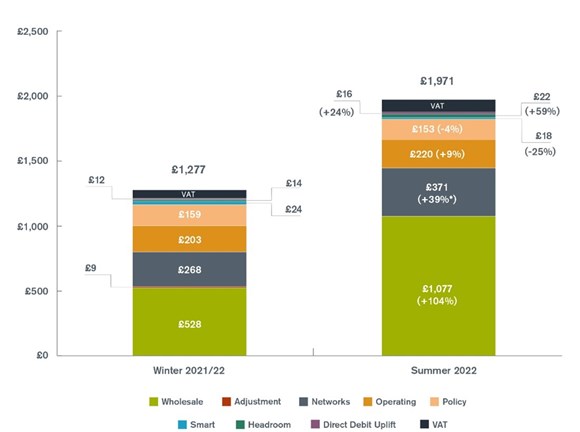
Dual fuel customer paying by direct debit, typical energy use (GB
£)
*Network costs: The main driver of this increase is the recovery
of Supplier of Last Resort (SoLR) levy costs (£68). A supplier
acting as a SoLR can make a claim for any reasonable additional,
otherwise unrecoverable, costs they incur. These levy claims are
paid to energy companies by the distribution network companies
and recovered from consumers via their charges.
- The charts below show the wholesale prices that are used to
determine the wholesale cost allowance within the price cap from
spring 2018 ahead of the introduction of the price cap in January
2019. Wholesale costs make up the majority of a customer’s bill.
An efficient supplier will purchase energy for their customers on
the wholesale market in advance of when they need to supply that
energy. This purchasing strategy is reflected in how the
wholesale allowance is calculated within the price cap. We
observe the forward-looking energy contracts that energy
companies typically purchase over time and combine these to
determine the wholesale cost allowance within the price cap. We
do this twice a year when we update the price cap in August for
the winter period (October - March) and in February for the
summer period (April - September) based on the price of these
forward-looking energy contracts over the previous six months.
The fixed horizontal line shows the average wholesale cost
allowance for each 6 month price cap period based on the price of
the relevant forward looking energy contracts (the jagged line).
The recent spike in the prices of relevant forward looking energy
contracts over the last 6 months can be clearly seen. The scale
and pace of wholesale price increases has resulted in a big
increase in the wholesale cost allowance for the price cap level
for summer 2022.
Wholesale gas price costs in the energy price
cap
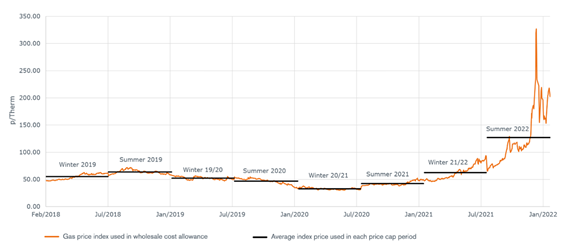
Pence per therm
Wholesale electricity price costs in the energy price
cap
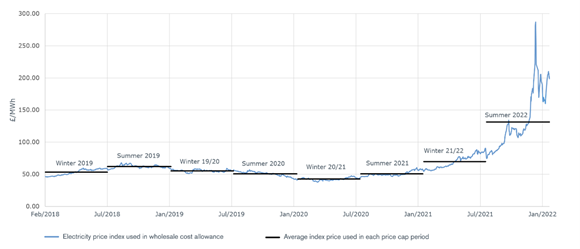
Pounds per megawatt hour
Data sets behind these graphs are proprietary and can be sourced
from ICIS.
- Information and materials for consumers about the price caps
is available at: www.ofgem.gov.uk/energy-price-caps.
Information on support and advice for consumers worried about
paying their bills is available at: www.ofgem.gov.uk/help-with-bills
