Blog for The Work Foundation by Heather
Taylor and Rebecca
Florisson
We are beginning to see the true impact of the COVID-19 crisis on
unemployment reflected in this month’s
quarterly release. Given the increase in short term
unemployment, combined with hundreds of thousands of planned
redundancies and the winding down of the furlough scheme in
October, we expect to see a shift towards longer term
unemployment, with young and older workers facing particular
risks.
The Coronavirus Job Retention Scheme continues to sustain high
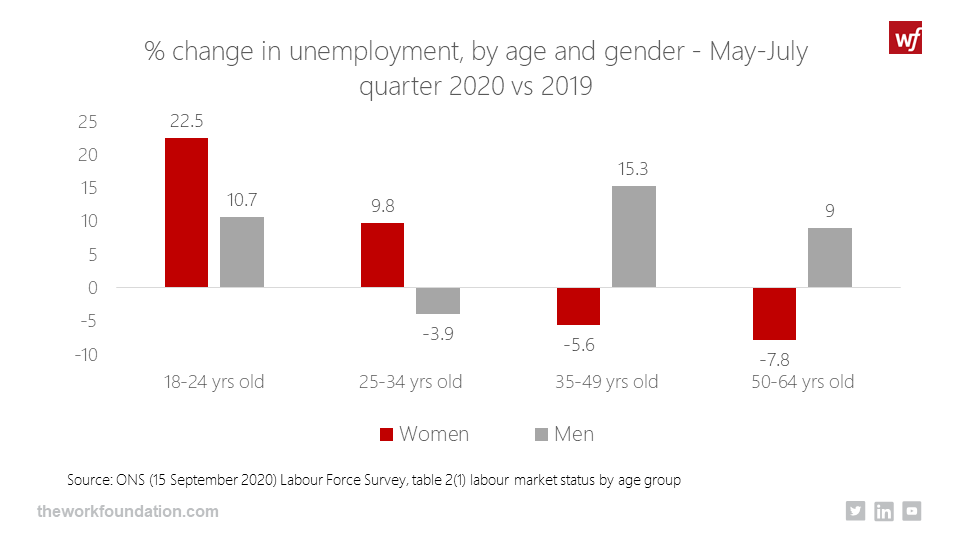
employment rates. Today’s data shows unemployment increased by
just 4.1% since the last quarter. This was driven by short-term
unemployment, with a particularly strong increase for women aged
18-24, who saw unemployment increase by 22.5% since last year.
These are worrying signs, given that we are at the early stages
of the crisis. There were 695,000 fewer people on payroll in
August than in March 2020 according to HMRC PAYE data. In
addition, 700,000 redundancies are planned for the third and
final quarter this year according to forecasts from IES.
An additional wave of redundancies is likely to hit when the
furlough scheme ends in October.
Currently, there are nearly 4 unemployed workers per vacancy and
that is set to increase when furlough ends. Considering the slow
recovery in vacancies, now at 53% of where they were before the
crisis (December-February), a higher number of workers will be
competing for a shrinking number of opportunities. As such,
although the Government’s investment in additional Work Coaches
at Job Centre Plus will provide welcome and important support to
unemployed workers, there will still be four times as many people
looking for jobs as there are jobs available.
In light of this, if those who have been laid off recently aren’t
able to find alternative work soon, longer term unemployment will
be set to rise. We know from previous recessions that longer term
unemployment may have scarring effects, including lower pay and
higher unemployment, particularly for younger workers (see for
example Bell &
Blanchflower).
There need to be stronger demand-side measures and incentives to
bring back furloughed workers, and foster job replacement and
creation. For example, offering a reduction in Employer National
Insurance Contributions would reduce the costs associated with
hiring and retaining staff, and could therefore encourage
employers to employ Kickstart participants after their placement
ends and/or hire other workers.
It is positive to see the launch of the Kickstart Scheme which
aims to mitigate these effects for young people, given similar
subsidised placement programmes have a significant positive
impact on the likelihood of young people moving in to work and/or
off benefits. For example, participants in the Future
Jobs Fund Programme were 11 percentage points more likely to
be in unsubsidised employment two years after starting the FJF
programme. However, with Kickstart placements only available to
those on Universal Credit, it is likely that many young people
will fall through the gaps and be left with little support to
re-enter the labour market.
Further, given the wider economic context, there will need to be
a longer-term strategy to ensure the young people who participate
in the scheme remain in employment/training after the placement
ends.
The Government have also announced payments to employers who hire
new apprentices. While this incentive will no doubt be a welcome
bonus for firms already planning to hire new apprentices, it is
unlikely to be enough to encourage those who previously couldn’t
afford the wages and associated hiring costs to change their mind
on hiring new apprentices.
Prior to the coronavirus crisis, the apprenticeship system was
not working well. According to government
data, apprenticeship starts in England have continued to
decline since the introduction of the apprenticeship levy in May
2017. Furthermore, a recent
report from the Social Mobility Commission highlighted that
participation in apprenticeships among those from disadvantaged
backgrounds is limited.
As such, it is vital that new apprenticeships and Kickstart
placements are explicitly marketed towards cohorts who stand to
benefit the most.
