
Foreign travel advice: Israel
|
Summary Still current at: 10 March 2020 Updated: 10 March 2020
Latest update: Additional entry restrictions introduced from 9
March 2020 (Summary) Download map (PDF) This travel advice covers
Israel and the Occupied Palestinian Territories The Foreign and
Commonwealth Office (FCO) advise against all travel to:
Gaza...Request free trial
Summary
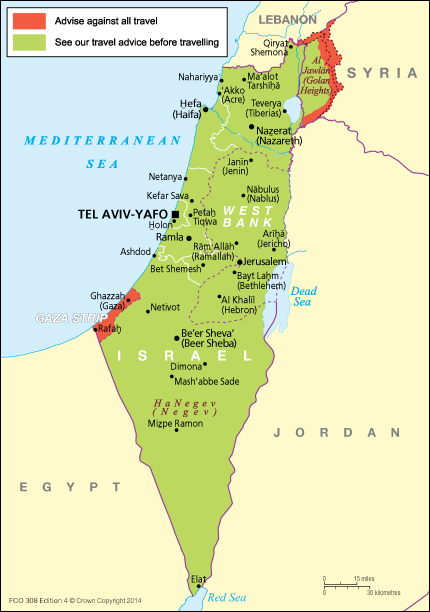 Download map (PDF) Download map (PDF)
This travel advice covers Israel and the Occupied Palestinian Territories The Foreign and Commonwealth Office (FCO) advise against all travel to:
There is an ongoing outbreak of coronavirus (COVID-19) in China, but cases have been confirmed elsewhere, including in Israel and the Occupied Palestinian Territories. The Israeli and Palestinian authorities have introduced a number of precautionary measures. See Health On 9 March 2020 Prime Minster Netanyahu announced that arrivals entering Israel from overseas would be subject to home quarantine measures for 14 days on public health grounds. This decision will be reviewed in 14 days. Visitors who are unable to demonstrate they can undertake the home quarantine measures will be refused entry into Israel. The Israeli authorities have recommended that visitors who are already in Israel will be given 72 hours to leave. Visitors should follow the following guidance:
We recommend checking Israel’s Ministry of Health website for updated information. Following the death of Iranian General Qasem Soleimani in a US strike in Baghdad on 3 January, the incident has led to increased tensions in the region. There is a possibility of an increased threat against Western interests and the security situation could worsen with little warning. You should remain vigilant and keep up to date with the latest developments, including via the media and this travel advice. The security situation in Israel and the Occupied Palestinian Territories can be fast moving, tense and unpredictable. You should be vigilant at all times and keep up to date with local media and travel reports. There have been calls for protests in the West Bank following political announcements on 28 January 2020. You should avoid all demonstrations and large gatherings. On 12 November 2019, more than 60 rockets were launched from Gaza into Southern Israel and towards Rishon Le Zion and Holon. At least two rockets were intercepted over Tel Aviv. Israeli Home Front Command have declared an emergency situation in Southern Israel, ordering all schools and work places to remain closed including in Tel Aviv. Keep up to date with Home Front Command for further information and advice. Terrorists are very likely to try to carry out attacks in Israel and the Occupied Palestinian Territories. Attacks could be indiscriminate, including places frequented by foreigners, and on public transport. See Terrorism There have been repeated instances of rocket fire from Gaza, which may occur well beyond the Gaza border area; Israel has often responded by returning projectile fire into Gaza. On 14 March and 25 March 2019 projectiles were fired from Gaza towards central Israel. On 25 March, a rocket hit a home in Mishmeret, north of Tel Aviv. If travelling in central or southern Israel, familiarise yourself with the safety actions that you should take in the event of a warning siren, follow advice from local authorities and stay informed of the security situation through the media and this travel advice. There have been mass protests on the Gazan side of the Gaza/Israel perimeter fence since March 2018. These protests may continue for some time. See Gaza There are significant tensions between Israel, and the Assad regime and Iranian military forces in Syria. On 21 January 2019, the Israeli Air Force stated that it had struck Iranian military assets in Syria, in response to missile fire towards the Israeli-occupied Golan. The situation remains fragile, and could change quickly. If travelling in the area remain vigilant, follow advice from local authorities and stay informed of the security situation through the media and this travel advice. There are continued heightened tensions between Israel and Lebanon. The situation on the ground could change quickly. On 1 September 2019 there was an exchange of fire between the militant group Hizballah and the Israeli Defence Force across the Blue Line, with material damage but no reported injuries on either side. See Border with Lebanon Make sure you’re aware of Israeli immigration policies before you travel. Allow extra time for increased security measures and checks at airports during Israeli holidays and during the peak summer tourist season. See Entry requirements In Israel and the West Bank, including Tel Aviv, East Jerusalem and the Old City (particularly the Damascus Gate and Lion’s Gate areas of the Old City) and Hebron, there have been numerous violent clashes between protestors and security forces and stabbing, shooting, arson, vehicle ramming and stone throwing attacks on people and vehicles. These types of incidents also happen along Route 60 within the West Bank (the main road connecting Jerusalem with Nablus and Hebron) and along Route 443 between Tel Aviv and Jerusalem. There’s a risk that tourists or bystanders could be caught up in any incident. You should avoid any demonstrations and follow instructions of local authorities. Be especially vigilant and take great care at the Qalandiya checkpoint between East Jerusalem and Ramallah, in areas close to refugee camps, in and around Israeli settlements and in the cities of Jenin, Nablus and Ramallah. There have also been several violent incidents in the northern West Bank area (north of Tappuah). Individuals carrying weapons have been arrested in Nablus. There is a risk of increased tension around Jewish high holidays (Passover, Rosh Hashana, Yom Kippur and Succoth) and after Friday prayers and on religious holidays. Demonstrations and other forms of civil unrest can occur at short notice and often turn violent. See Safety and security If you are abroad and you need emergency help from the UK government, contact the nearest British embassy, consulate or high commission. Consular support is severely limited in parts of the Occupied Palestinian Territories and Occupied Golan Heights where the FCO advise against all travel. The Overseas Business Risk service offers information and advice for British companies operating overseas on how to manage political, economic, and business security-related risks. Take out comprehensive travel and medical insurance before you travel. |